


Distance
14.1kmTime
26minsVenetian fortress in Nafplio built in 1711
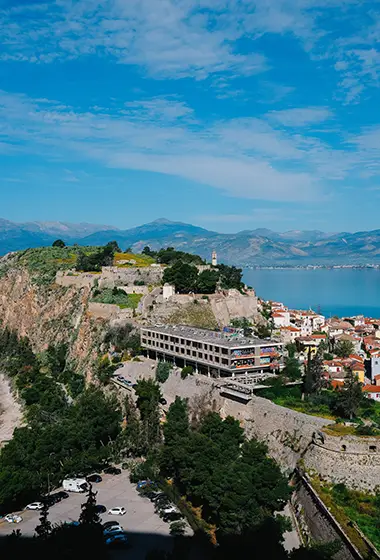
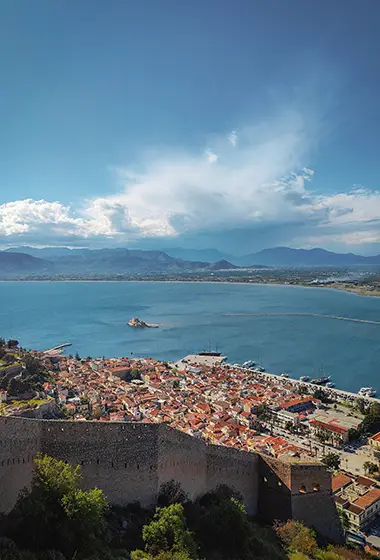
A striking Venetian stronghold that seamlessly integrates into its natural environment as though it belongs there. Constructed in 1687 by the Venetian Morosini, it was designed to function as a defensive position for the city. The final construction of the fortifications, created by Grimani, was finalized between 1711 and 1714. The church of Agios Andreas, constructed during the Venetian rule, remains situated at the highest elevation. The fortress features enormous thick walls and eight bastions, with one serving as a prison for the revolutionary hero, Theodoros Kolokotronis. Although it was claimed to be invulnerable, in 1715, during the final Venetian-Turkish War, the Ottomans captured the city by detonating sections of the walls. In the Greek War of Independence in 1821, the Turks fortified themselves in Palamidi, but on November 30, 1822, the Greeks triumphed following a battle commanded by Staikos Staikopoulos along with just 300 soldiers. Following the liberation struggle, Palamidi functioned as a prison, with Theodoros Kolokotronis incarcerated there in 1833 and freed 11 months later due to a decree from King Otto. The towering ramparts of the Palamidi castle rise prominently on the 216-meter tall rocky hill at the edge of Nafplio. Today, Palamidi attracts numerous visitors year-round, who are captivated not just by the stunning fortress but also by the spectacular scenery. Access to Palamidi can be reached by vehicle from the eastern side of the hill. For the bold individuals with sufficient endurance, there are 999 steps that ascend to the castle. Ascending to Palamidi, the stunning scenery will surely make up for the challenging trek